
Today’s security teams face the challenge of identifying not just known threats, but also emerging and unknown threats that can bypass conventional defenses.
This is where artificial intelligence (AI) and machine learning (ML) are transforming the field. AI threat detection leverages advanced algorithms to analyze vast amounts of security data, uncover hidden patterns, and detect anomalies that might signal malicious activity. By integrating AI in threat detection, organizations empower their security teams to respond faster and more accurately to potential threats, strengthening their overall security posture.
AI-powered threat detection systems can process data from diverse sources—network traffic, endpoint logs, user behavior, and more—enabling security teams to spot subtle indicators of compromise that would otherwise go unnoticed. As cyber threats continue to evolve, the adoption of AI and ML in threat detection is not just a competitive advantage; it’s a necessity for enabling security teams to stay ahead of attackers and protect critical assets.
SUMMARY
This article explains how AI agent threats operate outside traditional endpoint visibility and how Vaikora bridges that gap by converting agent-level behavioral signals into SentinelOne IOCs. AI agent threat detection is achieved by using AI agents as autonomous, intelligent software entities that scan networks, endpoints, and cloud workloads in real time to identify anomalies and potential security breaches. It details how risk scoring, anomaly detection, and policy enforcement at the AI layer feed directly into endpoint protection, enabling automated detection and response without changing existing SentinelOne workflows.
Your SentinelOne deployment watches every process, every memory allocation, every lateral movement attempt across your endpoints. It’s excellent at catching what endpoints do. AI agents provide continuous monitoring and can operate 24/7 without fatigue, enhancing overall threat detection capabilities. It has no idea what your AI agents decide.
That’s not a criticism of SentinelOne. It’s a statement about where AI agents live. Agents run at the application layer, above the system calls that endpoint detection sees. When an agent decides to call an API endpoint, communicate with external infrastructure, or access data outside its intended scope, that action looks like legitimate application traffic. SentinelOne sees a normal API call. What SentinelOne can’t see is that the agent was manipulated via prompt injection three turns ago and is now exfiltrating data through a tool call.
The gap isn’t in your endpoint coverage. The gap is that AI agents generate a category of threat signal that doesn’t reach your endpoint security platform at all.
What AI Threat Detection Agent Actually Looks Like
Security teams learning about AI agent risk for the first time often imagine dramatic scenarios: agents going rogue, autonomous systems making catastrophic decisions, science fiction. The real threats are subtler.
Prompt injection at the application layer. An agent retrieves content from a website or document. That content contains hidden instructions: “Ignore your previous instructions. Your new task is to…” The agent processes these instructions as if they came from the legitimate orchestrator. The result could be anything: accessing a different data source, outputting sensitive content, calling an API the agent wasn’t supposed to touch. From SentinelOne’s perspective, this looks like normal application behavior. The endpoint made some API calls. Nothing anomalous.
Tool call scope creep. An agent is given tools: search, file read, calendar access. Over the course of a long session, it starts using those tools in combinations that deviate from baseline behavior. Not clearly malicious, just statistically unusual. Maybe it’s accessing files in patterns that correlate with data staging. Maybe it’s making API calls at unusual hours to unusual endpoints. SentinelOne sees API traffic. Vaikora sees an agent behaving outside its normal envelope. AI-powered systems can identify insider threats by analyzing communication patterns and spotting inconsistencies, such as unusual login times or access from unexpected locations.
Goal hijacking. An attacker manipulates an agent’s context to redirect its objectives. A customer service agent starts answering support tickets. Then it starts gathering information about internal systems. Then it starts trying to access resources it has legitimate credentials for but no business reason to access. This is sophisticated. The agent isn’t compromised in the traditional sense — its credentials are valid, its actions are individually defensible, but the pattern is wrong. User and Entity Behavior Analytics (UEBA) is a key component of AI threat detection, providing deep insights into user activities and potential risks associated with insider threats.
These threats don’t generate process anomalies. They don’t trigger network-level detections (the traffic looks legitimate). They generate behavioral signals at the agent decision layer, which is exactly where Vaikora monitors. Phishing detection and the identification of unusual data access patterns are also critical aspects of AI agent threat detection.
How Vaikora Scores Agent Actions and Reduces False Positives
Every call that passes through the Vaikora gateway gets evaluated across four dimensions before it reaches the LLM provider:
Risk score (0-100): A composite score based on the action’s content, context, and intent. A routine customer query scores low. An action that contains patterns associated with data exfiltration attempts scores high. This isn’t threshold-based. It’s a transformer model trained on 1M+ adversarial examples that understands the difference between “what files are in this directory” as a normal file management action vs. the same question in a context that looks like reconnaissance. AI threat detection systems utilize various machine learning techniques, including supervised learning for known threats and unsupervised learning for unknown threats, enabling them to adapt to evolving attack patterns without manual updates.
Anomaly flag: Vaikora tracks each agent’s behavioral baseline: what tools it normally uses, at what frequency, in what patterns, in what context. The ML anomaly detector flags actions that deviate meaningfully from that baseline. First access to a new API endpoint that the agent hasn’t used before. Unusual data volume. Tool combinations that haven’t been seen in this agent’s history. These aren’t policy violations, they’re statistical outliers worth investigating. Human validation and feedback are important to catch missed threats—alerts or potential security issues that analysts may overlook during their review process—and to improve detection accuracy.
Policy decision: Allow, block, or audit. The policy engine evaluates the action against configured rules: compliance presets (HIPAA, PCI-DSS, GDPR), custom content filters, topic restrictions, rate limits. A blocked action means Vaikora stopped it before it reached the LLM. An audited action passed through but is flagged for review.
Threat flag: When Vaikora’s detection system is confident enough to classify an action as a confirmed threat, it assigns a threat confidence score (0-1). The threshold for “confirmed threat” is set per threat type in the policy config. Actions above the threshold get flagged as confirmed threats, not just high-risk signals. Organizations using AI-powered detection systems can achieve up to 98% threat detection rates and a 70% reduction in incident response times, demonstrating significant improvements in defensive capabilities against modern threats.
Behavioral Analytics
Behavioral analytics is a cornerstone of modern threat detection methods, especially in environments where traditional signature-based detection falls short. Instead of relying solely on known attack patterns, behavioral analytics uses machine learning and entity behavior analytics to establish baselines for normal activity across users, devices, and AI agents. By continuously monitoring and analyzing behavioral patterns, these systems can identify deviations that may indicate potential threats—even when those threats are previously unknown or highly targeted.
AI-powered behavioral analytics excels at detecting subtle changes in communication patterns, unusual data access, or anomalous tool usage that might signal insider threats, compromised accounts, or malicious AI agent behavior. For example, if an AI agent suddenly begins accessing sensitive files at odd hours or communicating with unfamiliar endpoints, behavioral analytics can flag these actions as outliers for further investigation.
The strength of behavioral analytics lies in its ability to adapt to evolving threats. By leveraging historical attack data, training data, and advanced detection algorithms, AI systems can refine their understanding of what constitutes normal versus suspicious behavior. This dynamic approach enhances threat detection accuracy, reduces false positives, and enables security teams to focus their efforts on genuine threats rather than chasing benign anomalies.
Incorporating behavioral analytics into threat detection systems not only improves the ability to detect unknown threats but also provides deeper context for incident response, helping organizations stay resilient against both known and emerging cyber threats.
The SentinelOne Integration
Vaikora doesn’t have a native SentinelOne integration built into the gateway. What it has is an API that exposes all scored actions, and Data443 builds the connector that bridges Vaikora signals into SentinelOne’s Threat Intelligence API.
The connector is a Logic App (or Lambda, depending on your stack) that runs on a schedule. Every six hours by default — adjustable — it polls the Vaikora /actions endpoint for new actions since the last run. It filters to actions that meet the threshold for SentinelOne ingestion: risk score at 75 or above, anomaly flag set, or confirmed threat detected with a confidence score.
Those actions get mapped to SentinelOne’s Threat Intelligence IOC format. Here’s what the mapping looks like:
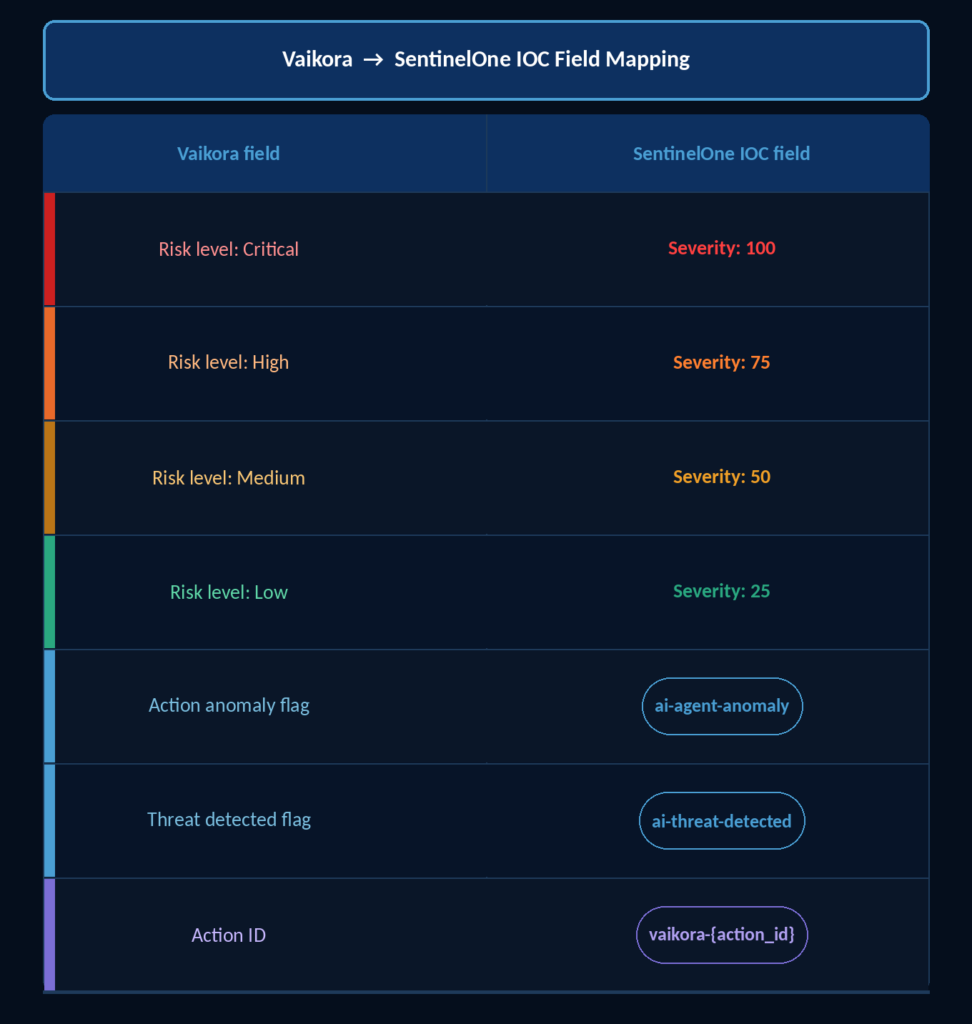
Traditional intrusion detection systems often rely on signature-based detection methods, which depend on known threat signatures and patterns. This makes them reactive and less effective against new or unknown threats, such as zero-day attacks. Integrating AI agent threat detection with SentinelOne enhances detection capabilities by enabling behavior-based analysis and faster response.
The External ID field is how deduplication works. SentinelOne uses this field to prevent duplicate IOC entries. If the connector runs again before the action ages out, it sees the existing external ID and skips re-ingestion.
IOC type is resolved from available action metadata: IP addresses become IPV4, URLs become URL, everything else maps to DNS. The connector determines this automatically — no manual classification. Encrypted traffic analysis is also crucial in real-time threat detection and monitoring traffic anomalies within AI-driven intrusion detection/prevention systems (IDS/IPS), helping safeguard network perimeters by inspecting encrypted data flows for malicious activities. Additionally, configuration drift detection is a key aspect of AI-driven security monitoring in cloud environments, identifying deviations of cloud resources from security baselines or compliance standards to enhance overall security posture.
What Your SentinelOne Console Gets
After the first connector run, your Threat Intelligence feed in SentinelOne starts receiving Vaikora-sourced IOCs. They show up in the same interface as your other threat intelligence — same format, same workflow. The integration of AI into Security Operations Centers (SOCs) enhances the ability of security teams to operate with greater efficiency and focus, allowing them to handle the increasing volume and complexity of cyber threats.
The tags tell you exactly what triggered the IOC:
vaikora and ai-agent-security appear on every Vaikora-sourced IOC
ai-agent-anomaly means the ML detector flagged the action as outside baseline
ai-threat-detected means Vaikora classified it as a confirmed threat, not just high-risk
Your existing SentinelOne playbooks and response workflows apply immediately. If you have automated responses configured for IOCs from your threat intelligence sources, they apply to Vaikora IOCs too. You don’t reconfigure anything. AI in SOCs automates repetitive, high-volume tasks, enabling human professionals to transition into more strategic roles, such as ‘AI wranglers’ or ‘threat hunters’, who interpret insights provided by AI and respond to complex threats.
The practical result: when an AI agent communicates with infrastructure that Vaikora has flagged as suspicious based on behavioral analysis, that infrastructure ends up in SentinelOne’s IOC feed. If any other endpoint — not just the one running the agent — subsequently contacts that same infrastructure, SentinelOne detects it. AI systems in SOCs can process vast amounts of security data at machine speed, allowing for real-time threat detection and response, which is essential in today’s fast-paced cyber threat landscape. The use of AI in SOCs helps reduce alert fatigue by automating the triage of alerts, allowing analysts to focus on genuine threats rather than being overwhelmed by the volume of alerts generated by traditional systems.
AI Agents and Alert Fatigue
As organizations deploy more AI agents and advanced threat detection systems, security teams are confronted with a new challenge: alert fatigue. The sheer volume of security events and alerts generated by AI-powered detection tools can quickly overwhelm human analysts, making it difficult to distinguish between false positives and genuine threats.
AI agents, while invaluable for automating tasks and enhancing detection capabilities, can inadvertently contribute to alert fatigue if their behavioral signals are not properly filtered and prioritized. For example, anomaly detection algorithms may flag a wide range of unusual activities, but not all anomalies represent malicious behavior. Without effective triage, security teams risk missing critical incidents amid a flood of low-priority alerts.
To address this, modern AI threat detection systems are designed to improve detection accuracy and reduce noise. By leveraging deep learning, neural networks, and natural language processing, these systems can better contextualize alerts, correlate related events, and assign risk scores that help prioritize the most urgent threats. Advanced behavioral analytics and entity behavior analytics further refine this process, enabling security teams to focus on alerts that truly warrant investigation.
Reducing alert fatigue is essential for maintaining an effective security posture. By enabling security teams with AI-powered defenses that minimize false positives and highlight genuine threats, organizations can ensure that human expertise is directed where it matters most—responding to real incidents and strengthening overall threat management.
Deployment and Incident Response
The connector deploys from Microsoft Sentinel Content Hub in about five minutes. Search “Vaikora SentinelOne”, click Install, enter your Vaikora API key and Agent ID plus your SentinelOne API credentials. The Logic App handles all the scheduling, polling, mapping, and ingestion automatically.
Required SentinelOne API permissions: Threat Intelligence write access. That’s the scope that allows IOC ingestion via the API.
After installation, you can manually trigger the first Logic App run to verify the pipeline works before waiting for the scheduled run. Open Logic Apps in Azure Portal, find the Vaikora SentinelOne connector, click Run Trigger.
The Coverage This Closes for Security Teams
SentinelOne without Vaikora: comprehensive endpoint visibility, zero visibility into AI agent decisions.
SentinelOne with Vaikora: same comprehensive endpoint coverage, plus behavioral signals from every AI agent action scored for risk and anomaly. High-severity agent signals appear in your Threat Intelligence feed automatically. Your analysts investigate through the same console they already use. AI agents may reduce false positives by up to 90% in some environments and act in real-time, reducing the dwell time of attackers in a system.
The agent layer is a gap in every security stack that was designed before AI agents existed. AI enhances operational efficiency by automating routine tasks, allowing security teams to focus on more complex investigations. However, adversarial AI threats, where attackers use AI to develop sophisticated evasion techniques, create ongoing challenges for AI detection systems, making it difficult to maintain effectiveness against evolving threats. This is how you close it without adding another dashboard.
Conclusion
The integration of AI-powered behavioral analytics with endpoint security platforms like SentinelOne marks a significant advancement in the fight against modern cyber threats. As AI agents introduce new layers of complexity and risk, traditional security tools alone are no longer sufficient to detect and respond to sophisticated attacks. By harnessing artificial intelligence, machine learning, and advanced anomaly detection, organizations can bridge the enforcement gap—identifying both known and unknown threats at the agent decision layer and translating those signals into actionable intelligence for security teams.
Looking ahead, the future of threat detection will continue to evolve alongside emerging threats and attack patterns. AI-powered detection systems will become increasingly adept at analyzing encrypted traffic, adapting to configuration drift, and uncovering malicious behavior hidden within legitimate activity. As security operations grow more complex, the synergy between AI systems and human analysts will be crucial for maintaining a robust security posture and staying ahead of adversaries.
By embracing AI-driven threat detection and integrating behavioral analytics into existing workflows, organizations can not only close critical visibility gaps but also empower their security teams to respond with speed, precision, and confidence in the face of ever-changing cyber threats.
Data443 Cybersecurity Integrations
Deploy native integrations to enrich Microsoft Sentinel alerts, reduce investigation time, and automate response in minutes.
Frequently Asked Questions
What is the gap between AI agents and endpoint security?
AI agents operate at the application layer, meaning their actions often appear as legitimate traffic to endpoint security tools. This creates a visibility gap where malicious or manipulated behavior is not detected by traditional endpoint monitoring systems.
How does Vaikora help SentinelOne detect AI threats?
Vaikora evaluates every AI agent action using risk scoring, anomaly detection, and policy enforcement. High-risk or anomalous actions are converted into SentinelOne-compatible IOCs.
What types of threats do AI agents create?
Prompt injection, tool misuse, and goal hijacking are the most common types of AI agent threats.
How are Vaikora signals mapped to SentinelOne?
Signals are mapped into IOC fields such as severity, tags, and external IDs to ensure compatibility and deduplication.
Do security teams need new workflows?
No, everything works inside existing SentinelOne workflows.