
The difference between a threat intelligence program that works and one that just generates data is the architecture connecting sources to enforcement. Most organizations get the first part right (connecting a feed to the SIEM) and stop there. The intelligence sits in a table. Analysts forget to query it. Six months later, someone asks what value the TI program provides and nobody has a good answer. Effective SIEM threat intelligence architecture relies on comprehensive data collection from a wide range of sources—including network devices, cloud services, and applications—and a systematic process that integrates both internal data and third-party threat intelligence to enrich detection and response capabilities.
SUMMARY
Most threat intelligence programs fail not because of the data, but because of poor architecture between ingestion and enforcement. This article explains how to design a scalable SIEM + threat intelligence architecture in Microsoft Sentinel using Codeless Connector Framework (CCF), structured data ingestion, KQL-based correlation, and Logic App enforcement. By connecting threat sources directly to endpoint protection platforms like CrowdStrike and SentinelOne, organizations can automate detection, reduce analyst workload, and operationalize intelligence in under 30 minutes.
Real threat intelligence integration means the feeds actively change how your SOC operates. This strengthens the organization’s security posture and defense against evolving threats. Alerts arrive with context already attached. High-confidence IOCs push to enforcement points without analyst intervention. Dashboards tell the shift manager what’s happening without them running ad hoc queries. The analyst’s job shifts from “gather context” to “make decisions.”
This article covers how to wire threat intelligence into SOC workflows that actually reduce workload instead of adding to it. Automation helps security teams reduce manual processes, improve detection coverage, and reduce MTTR.
This article covers the specific architecture pattern Data443 uses to connect threat intelligence sources to Microsoft Sentinel and then to endpoint enforcement platforms. The pattern handles multiple data sources, multiple enforcement targets, and deploys in under 30 minutes. Integrating threat intelligence into SIEM systems enhances their capability to detect and respond to security incidents by providing valuable context about known threats, including indicators of compromise (IOCs) and tactics used by cybercriminals.
Organizations that prioritize data sources by risk are 40% more effective at detecting and responding to threats. Threat intelligence feeds combine internal data with third-party data on threats and vulnerabilities, allowing SIEM systems to correlate internal events with external threat indicators for improved detection accuracy.
The architecture
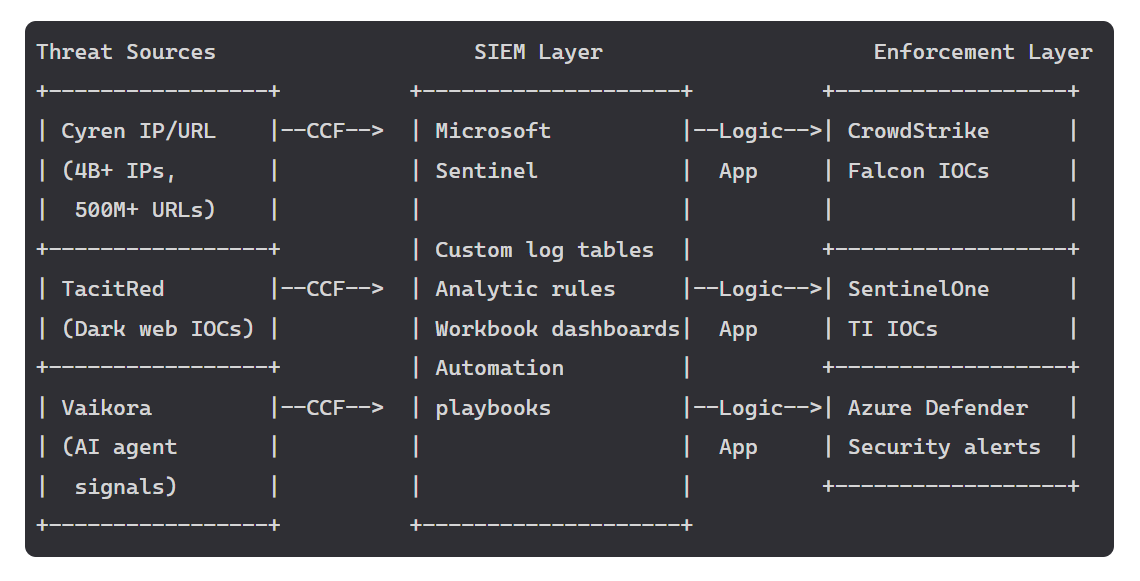
Three sources feed Sentinel through native data connectors. Sentinel stores, correlates, and evaluates. Logic App playbooks push high-confidence indicators to three enforcement targets. Each layer is independent, so you can deploy sources incrementally.
Data ingestion layer
Connector type: Codeless Connector Framework (CCF)
All Data443 connectors use CCF, the same framework Microsoft uses for first-party connectors. This is important for IT directors evaluating the integration. CCF connectors:
Install from Sentinel Content Hub with one click
Authenticate via API key (no service principal, no managed identity complexity)
Run as REST API pollers managed by Sentinel’s infrastructure
Handle pagination, deduplication, and scheduling automatically
Deploy no additional Azure resources (no Function Apps, no Logic Apps for ingestion)
The poller runs every 6 hours. Each poll retrieves all indicators since the last successful run. If a poll fails, the next one picks up where it left off.
Custom log tables
Each source gets its own table with a typed schema:
CyrenThreatIntelligence_CL stores IP reputation and malware URL indicators. Key fields: indicator value, risk score (0-100 numeric), indicator type (ip/url/domain), threat category, first seen, last seen, confidence level.
TacitRed_CL stores dark web credential leak IOCs and attack infrastructure indicators. Key fields: indicator value, source type, leak date, associated campaigns, confidence.
Vaikora_AgentSignals_CL stores AI agent behavioral signals. Key fields: agent_id, action_type, risk_score (0-100), anomaly_score (0.0-1.0), is_anomaly (bool), policy_decision (allow/block/audit), threat_detected (bool), severity.
Separate tables matter. They give you clean schemas optimized for each intelligence type. Your KQL queries run faster. Your analytic rules are simpler. Your workbooks can show source-specific metrics without filtering a generic table. Integrating identity logs from sources like Active Directory and Okta into your SIEM architecture further enhances detection of anomalous access, lateral movement, and privilege escalation by providing identity-centric data for analysis.
Data volume and cost
For IT directors tracking Azure costs: Log Analytics ingestion for threat intelligence feeds typically runs under $100/month for all three sources combined. The feeds are metadata (indicators, scores, timestamps), not full payloads. Data volume is predictable because it’s polling-based with fixed intervals.
Cloud-based SIEM architectures, particularly those utilizing data lakes, provide improved cost efficiency and scalability for storing large volumes of threat intelligence data. Data lakes enable organizations to store and analyze extensive historical data at a lower cost, supporting flexible expansion as data sources grow.
Log management and retention
Effective log management and retention are foundational to any robust SIEM architecture. Organizations generate massive volumes of log data from network devices, security systems, cloud services, and other critical infrastructure. Managing this data involves collecting, processing, and storing logs in a standardized format, which is essential for better detection and analysis of security incidents. Proper log management not only supports real-time security monitoring but also enables organizations to meet compliance requirements and conduct thorough forensic investigations when incidents occur.
Retention policies are often dictated by industry regulations and internal governance, requiring organizations to store log data for specific periods. Azure Blob Storage has emerged as a popular solution for log storage, offering scalable and cost-efficient options for managing large data volumes. By leveraging cloud-based storage, organizations can ensure that their log data is both accessible and secure, supporting compliance and forensic investigations while optimizing costs. Ultimately, effective log management and retention practices empower organizations to manage their security data efficiently, enhance detection capabilities, and maintain compliance across various systems and data sources.
Correlation layer
Analytic rules
Pre-built analytic rules ship with each connector. They’re disabled by default, ready to enable after confirming data flow.
The rules do two things: correlate threat indicators against your environment data, and generate alerts that notify security teams of potential security incidents. Effective alerting in SIEM architecture enables immediate notification to security teams when a potential security incident is detected, which is essential for rapid threat mitigation. These alerts then generate Sentinel incidents when matches occur.
Example correlation for Cyren IP intelligence:
let ThreatIPs = CyrenThreatIntelligence_CL
    | where TimeGenerated > ago(24h)
    | where risk_score_d >= 80
    | distinct indicator_s;
SigninLogs
    | where TimeGenerated > ago(1h)
    | where IPAddress in (ThreatIPs)
    | project TimeGenerated, UserPrincipalName, IPAddress, Location, ResultType
This joins high-confidence (score >= 80) Cyren indicators against your Azure AD sign-in logs. Any match generates an incident with the user, IP, location, and sign-in result pre-populated.
Tuning alert thresholds and managing false positives is crucial to reduce alert fatigue and improve detection accuracy. Implementing dynamic thresholds based on user and entity behavior can help identify slow-acting threats that might otherwise go unnoticed. As of 2018, nearly 93% of enterprises reported feeling overwhelmed by the volume of security alerts generated by their SIEM systems, highlighting the need for improved detection capabilities. Regular tuning of a SIEM system, including adjusting correlation rules and updating threat intelligence feeds, is necessary to maintain its effectiveness against evolving threats.
Similar rules exist for TacitRed (credential leak matches against your user directory) and Vaikora (high-risk agent actions and behavioral anomalies).
Workbook dashboards
Each connector ships with a workbook that provides visual monitoring:
Indicator ingestion volume over time (tells you the feed is healthy)
Match rate against environment data (tells you the feed is relevant)
Top matched indicators by frequency
Geographic distribution of matched threats
Feed health timeline (successful vs. failed polls)
Workbook dashboards provide critical insights by helping security teams prioritize data sources and focus on key information related to security threats, improving the efficacy of threat detection and response.
The SOC manager opens the workbook at shift start, confirms everything is flowing, and moves on.
Enforcement layer
Logic App playbooks
This is where intelligence converts to action. Logic App playbooks trigger when specific conditions are met (typically a high-confidence match from an analytic rule) and push the indicator to your endpoint security platform. While many SIEM enforcement integrations are now cloud-based, traditional on-premises deployments remain common and may require different integration approaches to accommodate hardware and connectivity constraints.
CrowdStrike Falcon integration:
Playbook authenticates via OAuth2 (Client ID + Secret)
Converts the indicator to Falcon Custom IOC format
Maps severity: critical = “prevent” mode, high = “detect” mode
Tags each IOC: source tag (cyren/tacitred/vaikora), threat type, ai-agent-anomaly if applicable
Sets external_id for deduplication
SentinelOne integration:
Playbook authenticates via API token
Pushes to Threat Intelligence API
Maps Vaikora risk scores to SentinelOne 0-7 severity scale
Creates a STAR detection rule on first run
Sets 90-day IOC validity window
Azure Defender integration:
Playbook writes to Vaikora_SecurityAlerts_CL
Sentinel analytic rules create incidents
Feed Outage Detection monitors pipeline
Execution cost
Logic App execution costs are minimal. Each playbook runs on a 6-hour trigger, processes a batch of indicators per run, and makes API calls in sequence. Typical monthly cost: under $10 across all playbooks.
Cloud-based SIEM solutions
Cloud-based SIEM solutions are transforming the way organizations approach security monitoring and incident response. By moving SIEM capabilities to the cloud, organizations gain access to scalable, cost-effective platforms that can handle the growing complexity and volume of security data. Microsoft Sentinel stands out as a leading cloud-based SIEM solution, providing security teams with advanced analytics, threat intelligence, and security orchestration capabilities.
These solutions offer enhanced threat detection by leveraging machine learning and entity behavior analytics to identify potential threats and security incidents in real time. Direct integration with cloud services allows organizations to seamlessly collect and analyze log data from a wide range of sources, including cloud-hosted applications and infrastructure. The flexibility of cloud-based SIEM enables organizations to scale resources as needed, ensuring predictable costs and efficient management of security operations. With features like automated incident response and advanced threat intelligence, cloud-based SIEM solutions empower organizations to stay ahead of evolving threats and maintain a strong security posture.
Permissions and prerequisites
| Component | Permissions Required |
|---|---|
|
Sentinel connectors |
Workspace read/write on Log Analytics |
|
Analytic rules |
Microsoft Sentinel Contributor |
|
Logic App playbooks |
Logic App Contributor |
|
CrowdStrike push |
Falcon API IOC write |
|
SentinelOne push |
Threat Intelligence write |
|
Azure Defender push |
Workspace ID + Key |
No global admin. No Azure AD admin consent. No network changes.
Deployment sequence
The full stack deploys in under 30 minutes:
Install Cyren connector (5 min)
Install TacitRed connector (5 min)
Install Vaikora connector (5 min)
Enable analytic rules (5 min)
Deploy playbooks (10 min)
What each ICP cares about
SOC analysts: Standard tables, flexible KQL, pre-built rules.
Security leadership: Coverage, cost, cost efficiency, no headcount increase, support for scalable and flexible SIEM architectures.
IT directors: Low risk, low maintenance, scalable, cost efficiency, support for large data volumes and ongoing system tuning.
In summary, SIEM architecture remains a cornerstone of effective security strategies, offering organizations a comprehensive approach to security monitoring and incident response. As cyber threats continue to evolve in sophistication and scale, modern SIEM architecture must adapt by integrating advanced analytics, machine learning, and threat intelligence to enhance threat detection and response capabilities. The future of SIEM is increasingly cloud-driven, with solutions like Microsoft Sentinel providing scalable, cost-effective, and flexible platforms for security teams.
By adopting cloud-based SIEM solutions, organizations can improve their security posture, streamline incident response, and maintain control over sensitive data. The integration of TacitRed threat intelligence and IOC automation further strengthens the ability to detect and respond to potential threats quickly and efficiently. As the security landscape continues to change, prioritizing SIEM architecture and leveraging the latest technologies will be essential for organizations seeking to protect their data, ensure compliance, and respond effectively to security incidents. Embracing these advancements will enable security teams to stay agile, proactive, and resilient in the face of emerging risks.
Data443 Cybersecurity Integrations
Deploy native integrations to enrich Microsoft Sentinel alerts, reduce investigation time, and automate response in minutes.